 Over 20 years of experience in Sterile, Biological Pharmaceutical and Hospital Facilities Engineering Design, Construction and Validation.


14 Jul How Adiabatic Cooling Boosts Efficiency in Run-Around Coil Pharmaceutical HVAC Systems
1. Introduction
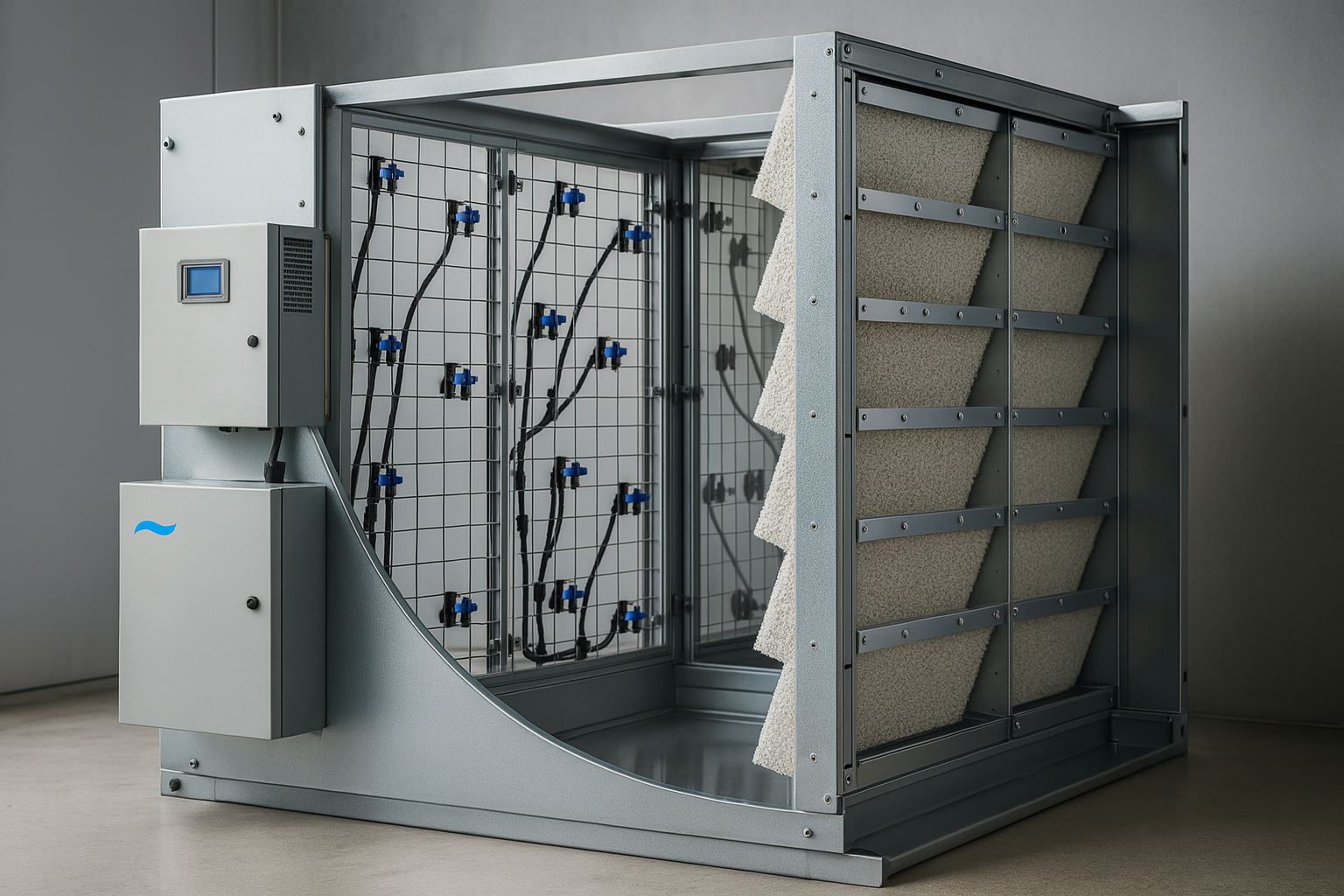
In the pharmaceutical industry, energy efficiency is a critical factor -not only for operational cost savings but also for sustainability goals. One commonly used system for energy recovery in HVAC design is the Run-Around Coil (RAC), particularly when direct enthalpy recovery is not feasible due to hygiene requirements or air stream separation. However, a powerful yet underutilized strategy to further enhance RAC system efficiency is the integration of adiabatic cooling on the exhaust side. In this post, we’ll see that Adiabatic cooling in pharmaceutical HVAC systems is becoming a key strategy to enhance energy efficiency while maintaining strict environmental control in cleanrooms.
2. Technical Background: How Adiabatic Cooling Works in RAC Systems
The Run-Around Coil system includes two heat exchangers: one located in the exhaust air stream and one in the supply air stream. A fluid (usually a glycol mix) circulates between them to transfer thermal energy. During the cooling season, the return air -typically cooler than outdoor air- pre-cools the fresh intake.
By adding adiabatic cooling upstream of the RAC coil in the exhaust, the return air temperature can be reduced even further through evaporative cooling. As water evaporates into the return air, the air temperature drops while its enthalpy increases, enhancing the thermal exchange with the supply coil -without adding any latent load to the supply air.
You can find out more about this in our last posts Run around coil optimization in pharmaceutical applications and Energy Savings in Pharmaceutical HVAC Design
3. Practical Example in a Pharmaceutical HVAC System
Consider a pharmaceutical HVAC installation where a RAC system handles:
- Outdoor air intake: 42,000 m3/h at 33.7 °C
- Exhaust air: 42,000 m3/h at 23,9 °C
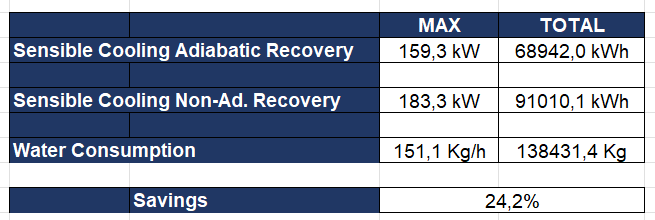
By integrating adiabatic cooling on the exhaust, the air temperature drops to 16.6 °C, enhancing the RAC’s effectiveness. The results?
- 24.2% increase in heat recovery efficiency
- Annual energy savings exceeding 22,000 kWh
- Estimated water consumption of 150 L/h during adiabatic operation, with an estimated 900 operating hours per year.
This demonstrates a high return on investment with a modest water footprint.
Note: The capital expenditure for the humidification system (humidifier unit, water supply, and control piping) and the cost of deionized water are not considered in this calculation. However, the energy savings significantly overweigh these opeational costs in most cases.
4. System Diagrams and Simulation
In our energy model, we used climatic data imports and hourly simulation identical to our standard analysis approach (see methodology in Airflow Reduction in Cleanrooms Operations HVAC Optimization).
Below are schematics comparing the non-adiabatic-enhanced RAC system layouts (click on the images to enlarge):
Non-Adiabatic
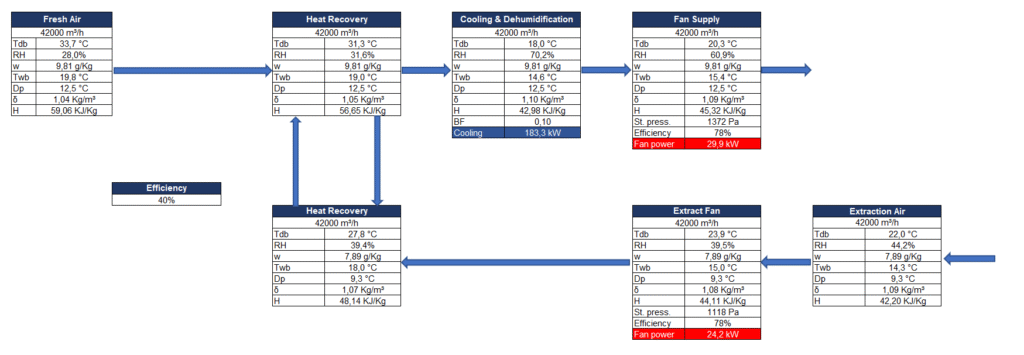
Adiabatic-enhanced

The table below provides a summary of the energy performance over a full year of simulation:
5. Design and Implementation Considerations
To safely implement adiabatic cooling in the exhaust stream, consider the following:
- Keep relative humidity below 85% to avoid condensation and corrosion risks.
- Select an appropriate adiabatic humidifier type (media pads, spray nozzles, ultrasonic) based on water quality, maintenance and control needs.
- Ensure sufficient drainage and airflow to prevent moisture accumulation inside ductwork.
Adiabatic cooling is specially advantageous in cleanroom HVAC systems where enthalpy wheels or direct exchange methods are not recommended.
6. Conclusions
Integrating adiabatic cooling into Run-Around Coil systems in pharmaceutical HVAC designs is a powerful energy efficiency measure. It improves cooling performance without introducing contamination risk respect GMP design principles, and significantly reduces chiller energy consumption.
For pharmaceutical manufacturing facilities committed to energy efficiency and operational excellence, this solution offers high performance at low cost -a win-win strategy.



Calvin
Posted at 17:29h, 08 AprilThank you for insightful ideas. May I look for your program schematics comparing the non-adiabatic-enhanced RAC? Thank you