 Over 20 years of experience in Sterile, Biological Pharmaceutical and Hospital Facilities Engineering Design, Construction and Validation.


09 Apr Airflow Reduction in Cleanrooms Operations HVAC Optimization
1. Introduction
Airflow reduction in cleanroom operations is a key strategy to optimize energy use in pharmaceutical HVAC systems. Cleanrooms require intensive air handling to meet environmental control standards, but reducing airflow during non-operational hours can significantly lower energy consumption while maintaining GMP compliance.
2. 📉 What Is Airflow Reduction Mode (ARM)?
Airflow Reduction Mode involves reducing air change rates when the cleanroom remains unoccupied—such as during nights, weekends, or production downtimes—while still maintaining required pressurization, filtration, and environmental monitoring.
ARM is not prohibited by GMP or ISO standards; on the contrary, guidelines like EU GMP Annex 1 and ISO 14644 focus on performance-based validation, allowing airflow reduction when contamination control is demonstrated.
3. 🧠 Why Cleanroom Air Change Rates Are Often Oversized
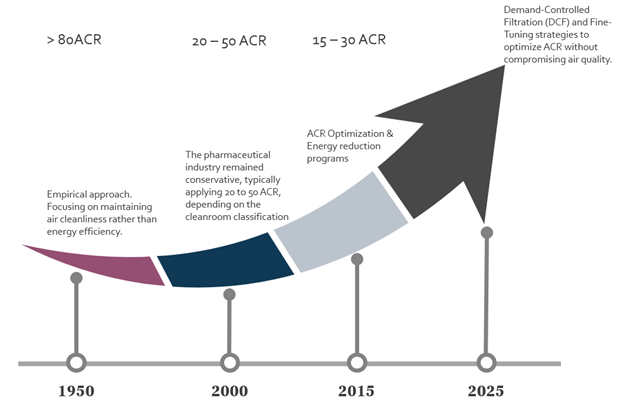
Historically, cleanrooms were designed conservatively, often with ACH of 20 to 50 or more, depending on classification.
Over the decades, the industry has evolved from empirical and conservative approaches to more data-driven and optimized strategies:
1950s: Empirical design, prioritizing air cleanliness.
1990s–2000s: Typical ACH ranged between 20 and 50, depending on classification.
2015 onwards: Programs for ACH optimization and energy reduction emerge.
2020+: Demand-Controlled Filtration (DCF) and fine-tuning strategies are introduced.
Although regulations like ISO 14644 or EU GMP Annex 1 do not explicitly mandate reducing ACH, aligning this strategy with particle generation analysis, risk assessments, and validation has made it viable.
Modern studies show that airflow effectiveness is more important than quantity.
HVAC systems consume more energy—up to 75% of total cleanroom energy use—when operating with oversized airflows.
4. 🧪 Key Considerations Before Reducing Cleanroom Airflow
To apply HVAC airflow optimization safely in a cleanroom, consider:
Regulatory compliance: Focus on particle control, pressure differentials, and recovery times, not ACH alone.
Occupancy patterns: Use ARM when no personnel are present, but maintain room classification.
Risk assessment and validation: Critical to ensure cleanliness and control parameters remain within specification.
5. 👥 Impact of Personnel and Machinery on Particle Generation
In controlled environments, personnel contribute the most to contamination. Studies like those by Zhonglin Xu have shown that human activity is a major source of particulate generation in cleanrooms show that:
- Walking, breathing, and movement release high particle loads.
- Full cleanroom gowning and return grilles near the floor (≤0.7 m) enhance contaminant removal.
- Operators must validate systems to ensure they maintain GMP-grade filtration performance, even when airflow is reduced.
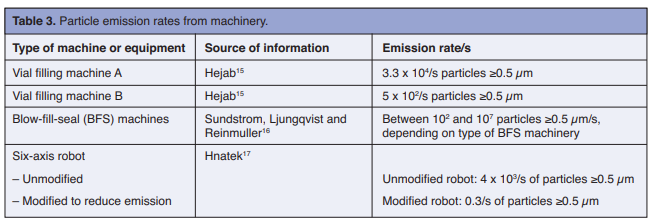
Calculation of air supply rates and concentrations of airborne contamination in non-UDAF cleanrooms
European Journal of Parenteral & Pharmaceutical Sciences 2017; 22(4): 126-138

Fundamentals of Air Cleaning Technology and Its Application in Cleanrooms
Zhonglin Xu – Ch.13 (2014)
6. 🛠️ Requirements for Applying Airflow Reduction Mode
Technical prerequisites:
- BMS integration to schedule and monitor airflow transitions.
- Automatic dampers and fan speed control for modulation.
- Room access lockout and alarms during ARM periods.
- Setback control for temperature and humidity during downtime.
Operational prerequisites:
- Apply ARM only during unoccupied periods.
- Pressure differentials must be maintained (per design).
- Facilities staff lock room access during ARM and activate visual indicators (beacons).
- Emergency override to return to normal airflow.
- Integration with occupancy detectors.
- Different temperature/humidity setpoints for occupied vs. reduced mode.
- Teams must document a change control and re-validation plan.
7. 🏭 Use Case: Airflow Reduction in Cleanroom Operations in a GMP Facility
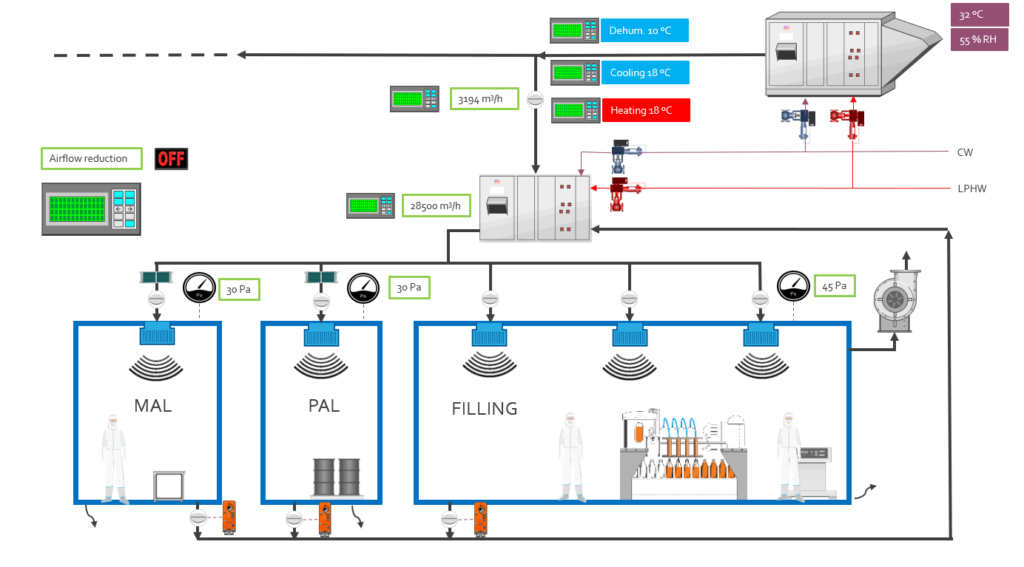
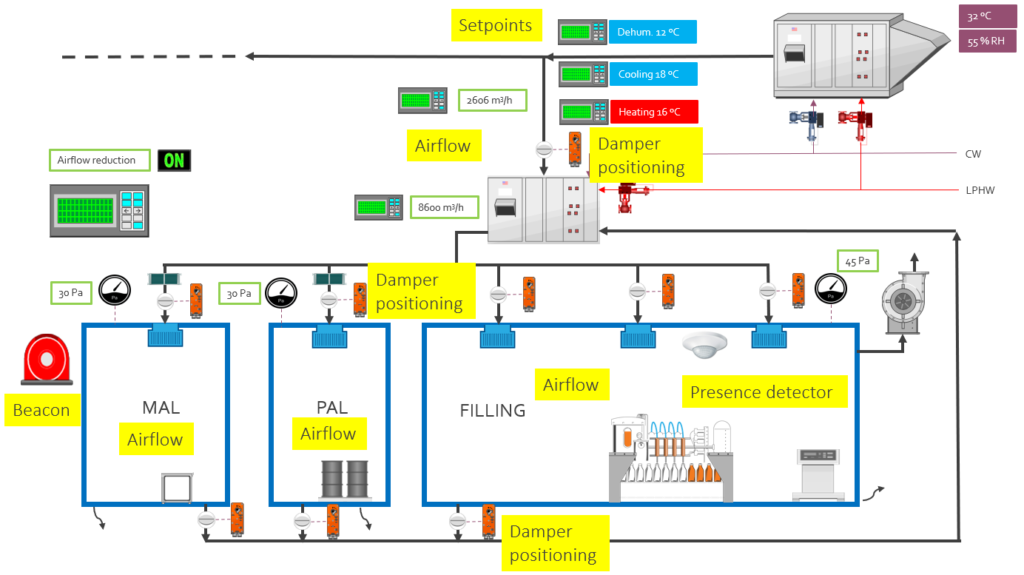
This real-world example demonstrates the benefits of applying airflow reduction in cleanroom operations, with automatic transition schedules and full compliance maintained.
In a two-shift vaccine manufacturing plant, ARM was applied from 10:00 pm to 6:00 am and during weekends. Actions included:
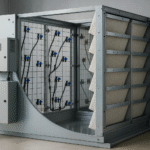
- Reducing airflow in both Make-Up Air Unit and Recirculation Units.
- Adjusting temperature and humidity setpoints and modulating damper positions.
- Ensuring that room pressure cascades and cleanliness were preserved.
Click on the images to enlarge.
7.1. 📊 Energy Analysis of Airflow Reduction Mode
To quantify the savings, a detailed annual energy demand simulation was performed. These were the steps followed:
- Development of an hourly outdoor climate profile.—this approach is further explained in our previous post How to import climatic data into Excel
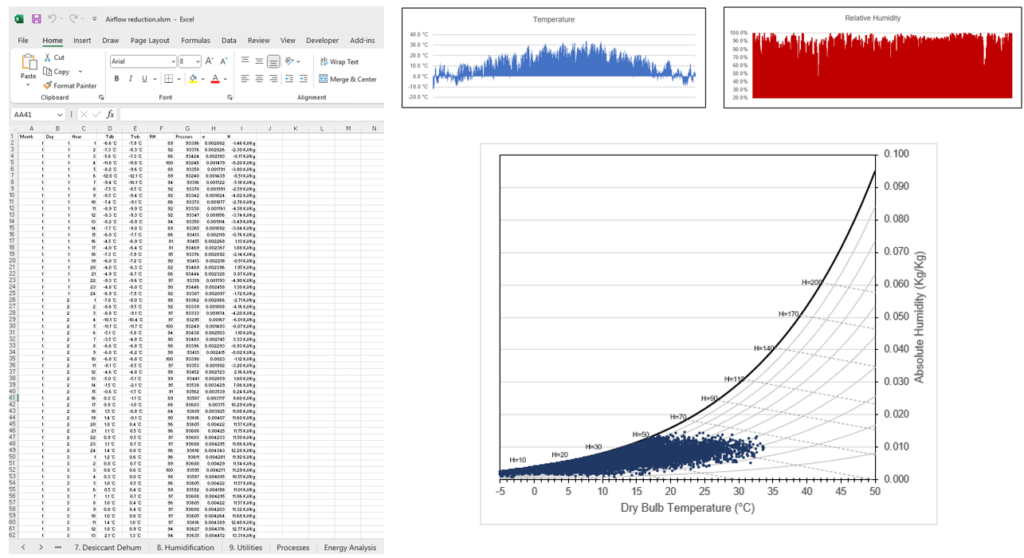
2. Definition of internal heat loads (equipment, lighting, people) and their operating schedules, both for normal mode and reduction mode.
3. Implementation of reduced lighting, lower air volumes, and setback of humidity and temperature setpoints during unoccupied periods.

4. For each hour of the year, the simulation determined whether heating, cooling, humidification, or dehumidification was needed for both primary and recirculated airflows.
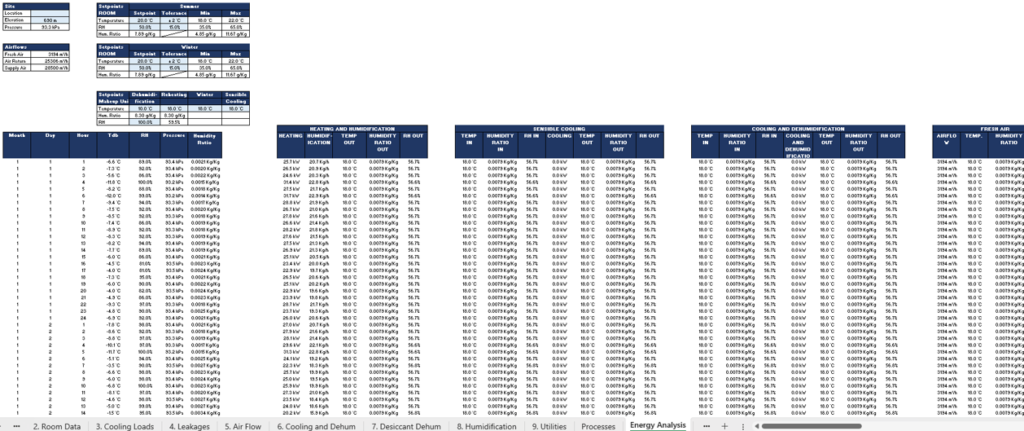
The outcome was a precise calculation of the annual energy demand for the HVAC system under ARM, providing clear visibility into potential savings and guiding design and control adjustments.
7.2. 💡 Energy Savings with Airflow Reduction Mode
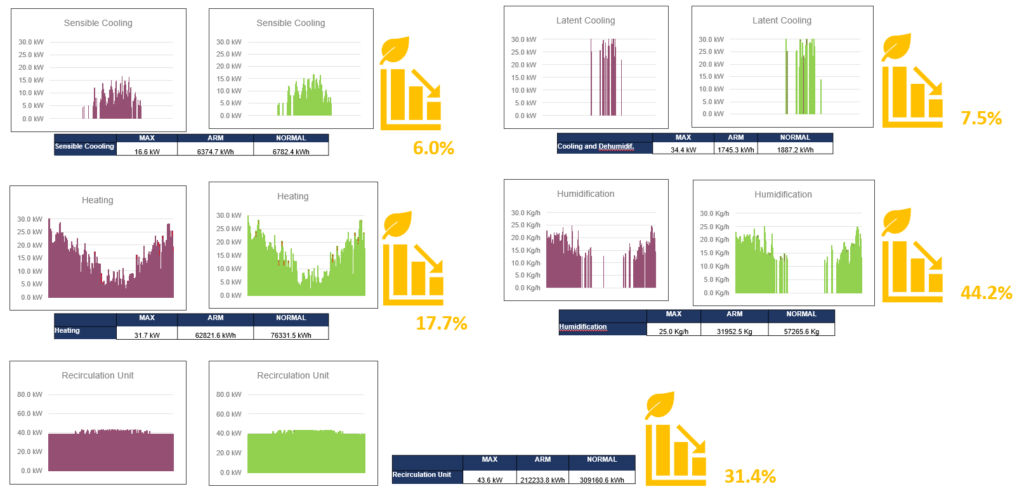
Simulations show:
- Make-Up Air Unit:
- 6% savings in sensible cooling
- 7.5% in latent cooling
- 17.7% in heating
- 44.2% in humidification
- Recirculation Unit:
- 31.4% savings in cooling load
- Fan Energy Reduction:
- 18.3% reduction in Make-Up unit
- 51.7% in recirculation unit
- Total ventilation savings: 43.4% during ARM periods
8. Conclusions
Airflow Reduction Mode is a validated, risk-based, and energy-efficient strategy that aligns with current GMP HVAC best practices. It enables facilities to:
- Lower HVAC operational costs
- Improve environmental sustainability
- Maintain full regulatory compliance
Implementing airflow reduction in cleanroom operations helps pharmaceutical facilities achieve sustainability goals without compromising process integrity or GMP compliance.
No Comments