 Over 20 years of experience in Sterile, Biological Pharmaceutical and Hospital Facilities Engineering Design, Construction and Validation.


28 Nov Plug fans or EC fans: Which is more efficient?
1. Introduction
In our previous post Energy Savings in Pharmaceutical HVAC Design, we briefly discussed using high-efficiency fans to reduce energy consumption in an HVAC system within a pharmaceutical environment. In this article, we will delve deeper into this topic and evaluate the advantages and disadvantages of each technology through a couple of specific cases, aiming to answer the question: “Plug fans or EC fans: which is more efficient?”
2. Plug fans
Before diving into the details, let’s explore the characteristics of both types of fans, starting with a plug fan.
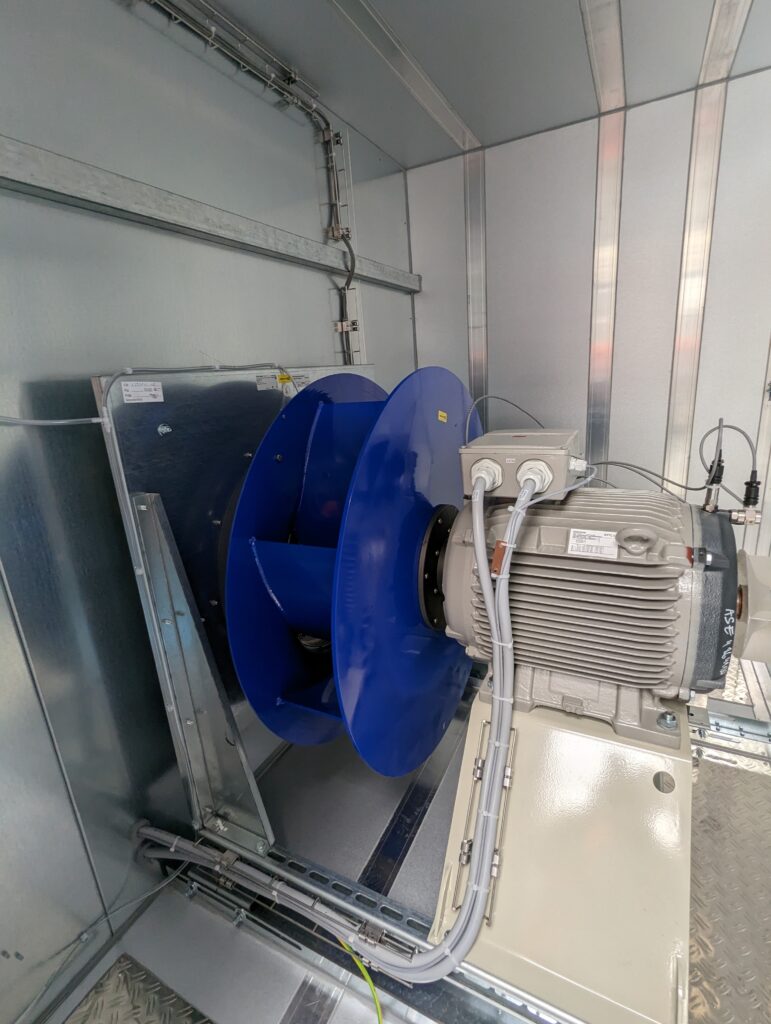
A plug fan, or direct-drive fan, is a type of centrifugal fan mounted directly onto an AC motor. This design eliminates the need for belts, making it more efficient. Unlike other centrifugal fans, the blades of a plug fan are fully exposed within the air handling unit (AHU) housing.
Additionally, plug fans are relatively easy to maintain due to the absence of belts and pulleys, reducing long-term costs. However, they can generate more noise due to the exposed blades.
Plug fans can provide high static pressures for large airflow rates, making them ideal for pharmaceutical industry applications. As we know, high pressure is required to overcome the significant pressure drop caused by HEPA filters.
3. EC Fans
An EC fan (electronically commutated fan) is powered by a DC brushless motor supplied via a standard AC connection. Another key feature is the integrated controller, which, unlike plug fans, eliminates the need for a separate variable frequency drive (VFD) to adjust motor speed.
EC fans typically offer higher efficiency compared to plug fans and generate less noise. However, they have a limitation: they can only provide high static pressure for smaller airflow rates. While this is not a problem in other industries, such as data centers, it is a concern for the pharmaceutical industry, as mentioned earlier. The solution lies in installing multiple EC fans in parallel, where the individual airflow rates of each fan combine to meet the required pressure.

3. Plug Fans or EC Fans: Which are more efficient?
With this context, let’s attempt to answer the question: “Plug fans or EC fans: which is more efficient?”
To do so, we will analyze energy consumption for two typical airflow and pressure conditions in a pharmaceutical HVAC system:
Case 1. 90,000 m³/h with a static pressure of 1915 Pa
Case 2. 22,500 m³/h with a static pressure of 1260 Pa
It’s well-known that static pressure is not constant over time as it depends on the condition of the filters, which gradually clog. However, for the purpose of this analysis, we will assume a constant pressure.
For calculations, we used software provided by two manufacturers: FanScout from Ebm Papst for EC fans and Fan Select from Ziehl Abegg for plug fans (Note: only IE4 fans have been considered!).
Additionally, for plug fans, we included a loss factor of 2% due to the VFDs, while EC fans were considered loss-free as they integrate their own electronics.
The main values compared are fan efficiency and SFP (Specific Fan Power). SFP is particularly relevant as it indicates the electrical power consumed per unit of airflow (electrical power divided by airflow). With a hypothetical kWh cost, we can estimate the annual operational cost for each type.
The analysis assumes continuous operation, 24/7, for a total of 8,760 hours per year.
When referring to EC fans, we use the term “Wall Fan.” Some manufacturers also call it a “Fan Grid” or “Fan Array” because it involves multiple fans working in parallel.
4.1. Case 1
The results are summarized in the table below (click on the image enlarge). For the high airflow rate in this case, three plug fans are required in parallel. Meanwhile, 11 EC fans are needed. This number may need to be adjusted depending on the dimensions of the AHU housing them, but the energy performance results should remain largely unaffected.
The results show that the wall fan setup achieves higher efficiency, resulting in a 3.23% reduction in operational costs.

4.2. Case 2
The results for a smaller-scale airflow and pressure scenario also favor the wall fan setup. In this case, only two EC fans are required, while a single plug fan is sufficient to meet the required airflow and pressure.
At a lower airflow rate, the efficiency of wall fans becomes even more evident, with cost savings increasing from 3.23% to 6.11%.

5. Conclusions
- In general, wall fans are slightly more efficient than plug fans. However, it’s worth noting that their relative efficiency decreases at higher airflow rates compared to lower ones.
- Redundancy. The requirement to install multiple fans in parallel makes it particularly advantageous to include a redundant fan for backup in case of failure.
- Operational cost savings, while significant, may not be the sole determining factor. Although wall fans are more efficient, the return on investment is not always clear. Including the purchase cost of both options would provide a clearer picture, but this is beyond the scope of this post.
- Finally, if redundancy is a priority, wall fans stand out as the best choice in this comparison.


No Comments